The impact of treatment strategies on the epidemiological dynamics of
plasmid-conferred antibiotic resistance
Mütter, Angst, Regoes, Bonhoeffer · PNAS · 2024
Abstract
The issue of antibiotic resistance is a critical concern for public health,
prompting numerous investigations into the impact of treatment strategies on
preventing or slowing down the emergence of resistance. While existing
studies have predominantly focused on chromosomal resistance mutations, the
consequences of often clinically more relevant plasmid-conferred resistance
remain insufficiently explored. To address this gap, we conducted three
extensive in vitro experiments utilizing a liquid-handling platform. These
experiments evaluated the efficacy of five distinct treatment strategies
using two antibiotics (tetracycline and ceftazidime) along with two
horizontally transmissible clinical resistance plasmids conferring the
respective resistances. Among the experimentally investigated treatment
strategies, combination therapy proved to be the most effective in
preventing the emergence of double resistance while minimizing the number of
infections. To verify the reliability of these findings, we constructed a
computational model of our experiments that we parameterized using the
experimental data. We employed this model to augment the experimental data
by conducting an in silico parameter sensitivity analysis. The sensitivity
analysis corroborated our experimental results, demonstrating that
combination therapy consistently outperformed other treatment strategies
across a range of parameter values.
Bacterial population decline at antibiotic concentrations above the minimum
inhibitory concentration (MIC) remains poorly characterized. This is because
colony-forming units (CFU), the standard method to quantify inhibition, are
slow, labor-intensive, and costly. Luminescence assays are widely used to
quantify population dynamics at subinhibitory concentrations, yet their
limitations and reliability at high concentrations remain underexplored.
Here, we compared luminescence- and CFU-based rates in Escherichia
coli across 20 antimicrobials. In our experiments, luminescence- and
CFU-based rates did not differ significantly for half of them. For the other
half, CFU-based decline rates were consistently higher. The estimates
differed for two main reasons: First, because light intensity tracks biomass
more closely than population size, luminescence declined more slowly than
the population when bacteria filamented. Second, CFU-based estimates
indicated a steeper decline when treatment reduced the number of colonies
formed per plated bacterium. This can result from changes in clustering
behavior, physiological changes that impair culturability, or antimicrobial
carryover. Thus, the suitability of luminescence to quantify bacterial
decline depends on the physiological effects of the antimicrobial and
whether the quantity of interest is cell number or biomass. Within these
limitations, luminescence can serve as an efficient, high-throughput
alternative for quantifying bacterial dynamics at super-MIC concentrations.
Antimicrobial Combination Effects at Sub-inhibitory Doses do not Reliably
Predict Effects at Inhibitory Concentrations
Mütter, Angst, Regoes, Bonhoeffer · bioRxiv preprint, in
revision at PLOS Biology
Abstract
Assessing whether drug combinations synergise or antagonise is difficult for
several reasons: (i) measuring bacterial death rates at clinically relevant
inhibitory drug concentrations is methodologically challenging, (ii) there is
no unifying definition of what constitutes synergy or antagonism, and (iii)
both synergy and antagonism may be concentration- and mixing-ratio-dependent.
To assess how well sub-inhibitory measurements predict inhibitory behaviour,
we quantified drug interactions for 15 pairwise drug combinations on a
concentration checkerboard covering a wide range of inhibitory and
sub-inhibitory concentrations. To this end, we tracked the population
dynamics of 8640 bioluminescent E. coli cultures by recording their
light-intensity trajectories. To handle time-varying treatment effects and
allow fair comparisons between drugs with distinct killing dynamics, we used
a time-weighted net growth rate ψ to summarise each trajectory and assigned
interaction labels (synergistic/independent/antagonistic) based on Bliss
independence and Loewe additivity. We found that the interaction label
depends on both the concentration and the mixing ratio, frequently changing
between the sub-inhibitory and inhibitory regimes. Characterising drug
combinations at a single sub-inhibitory concentration is therefore not
sufficient. Instead, their combined effects should be assessed at the
conditions of their intended use.
Experimental and Theoretical Investigations of Bacterial Population
Dynamics Under Multidrug Treatment
Doctoral thesis · ETH Zürich · 2026
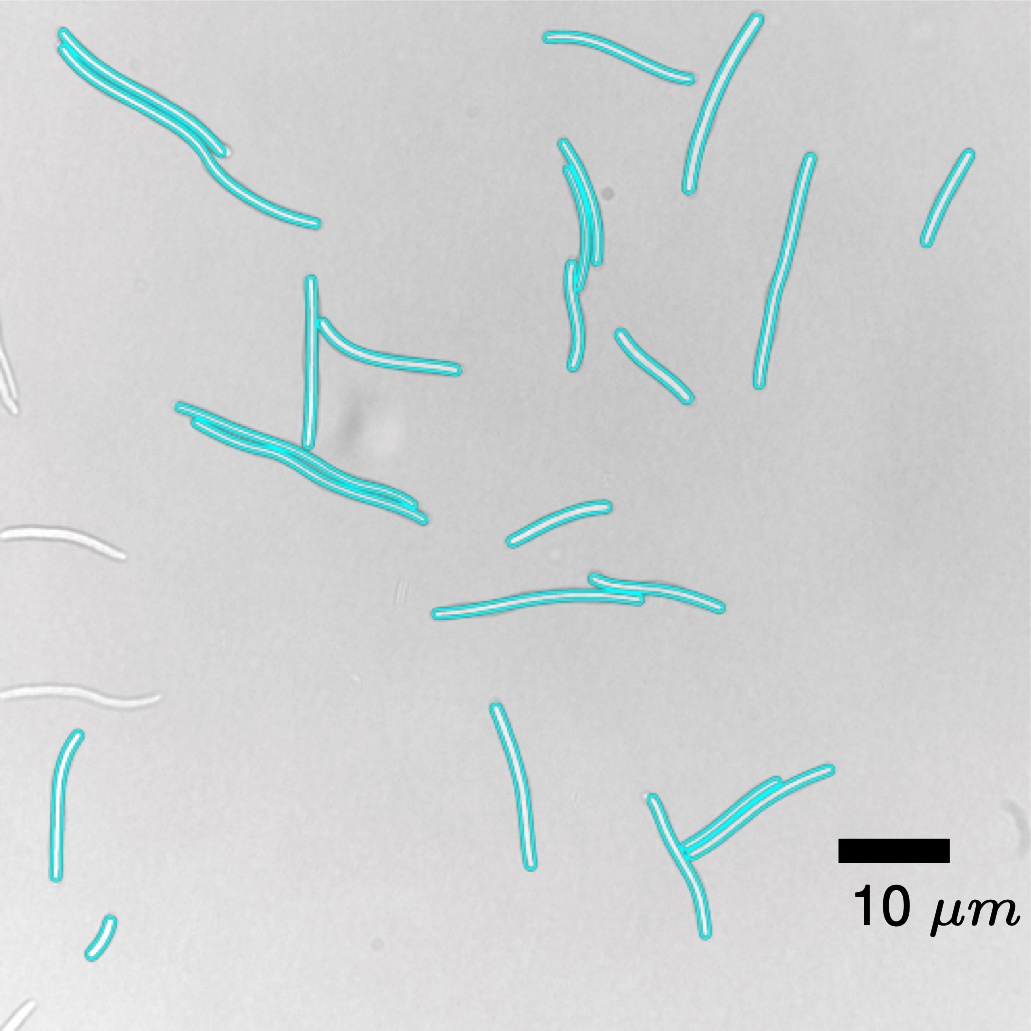
Filamented E. coli under the microscope, outlined by
the segmentation. Filamentation is one of the reasons light intensity
and cell number come apart: the biomass keeps growing while the
number of cells does not.Abstract
Since the discovery of penicillin, antibiotics have been a cornerstone
of modern medicine. This achievement is now under threat, as bacteria
have evolved resistance to antibiotics across all major drug classes.
Slowing the rise of resistance will require changes in how existing
antibiotics are deployed. In this thesis, we investigate the
pharmacodynamics of drug combinations and how multidrug treatment
strategies shape the dynamics of plasmid-mediated resistance.
In time-critical clinical emergencies such as sepsis, therapy cannot
wait for phenotypic susceptibility testing and therefore relies on
predefined empirical strategies. To assess how these strategies
affect the clearance probability and the plasmid-mediated emergence
of double resistance, we conducted large-scale automated in
vitro experiments that mimic hospital-like transmission
dynamics. Across most scenarios, treating with two antibiotics
simultaneously (combination therapy) was the most effective
strategy.
Because the effectiveness of combination therapy is shaped by drug
interactions (i.e. synergy, antagonism, or independence), we next set
out to quantify the treatment effects of several drug combinations.
To assess treatment effects under clinically relevant inhibitory
conditions in high throughput, we evaluated whether
bioluminescence-based light intensity is a suitable proxy for cell
number dynamics.
For 20 antimicrobials, we compared bioluminescence trajectories to
colony-forming unit (CFU) counts and supplemented these experiments
with microscopy imaging. We found that light intensity dynamics align
more closely with biomass dynamics than with cell number dynamics.
Accordingly, rates inferred from bioluminescence and from cell
numbers tend to align when cell size remains approximately constant.
Furthermore, we observed that CFU-based estimates can be biased by
drug-induced changes in culturability and by antibiotic
carry-over.
Using the bioluminescence method, we quantified antibiotic
interactions for 15 drug pairs across checkerboards spanning
sub-inhibitory to inhibitory concentrations. We found that
interaction types at sub-inhibitory concentrations frequently differ
from those at inhibitory concentrations. In addition, interaction
types can vary with mixing ratio and depend on the chosen reference
model. Together, these results highlight the potential of combination
therapy, provide methodological insights to optimise it, and caution
against uncritical extrapolation of findings across the measured
concentration space.
Development of a bioreactor for studying the evolution of resistance to
antibiotic combinations
Master's thesis · TU Berlin, with FU Berlin and Charité
(EvolChip project) · 2020
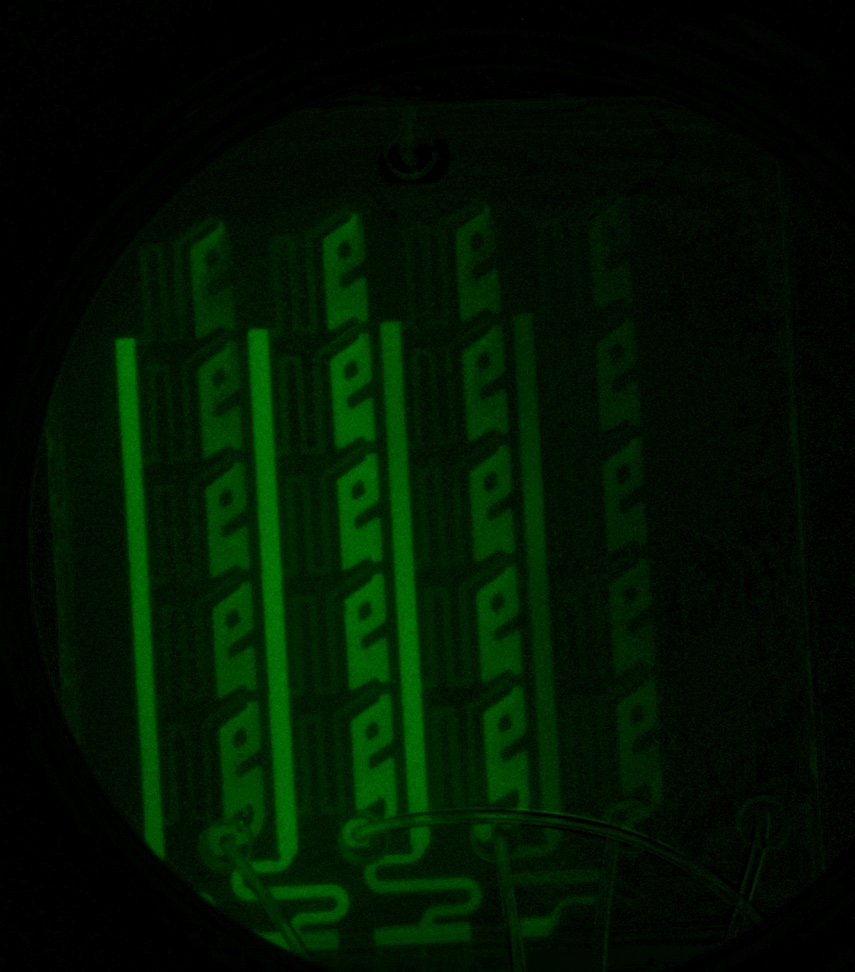
The microfluidic chip under fluorescence: the dye makes the
channel network visible, where two antibiotics are mixed at varying
ratios and diluted step by step across the device.Abstract (translated from German)
The rise of multidrug-resistant bacteria increasingly threatens the
achievements of antibiotic therapy: fewer new antibiotics are being
developed, and resistance appears ever earlier. Clinical practice
routinely tests bacteria for resistance to single antibiotics, but
rarely to combinations — even though combinations could contribute
substantially to containing resistance, and no published method exists
for estimating how likely resistance to a given combination is. This
thesis develops and tests such a method. Two drugs are mixed at varying
ratios inside a microfluidic structure and diluted stepwise. Bacteria
grow against the resulting concentration gradient until they reach the
minimum inhibitory concentration (MIC); once resistance mutations
occur, the MIC boundary shifts toward higher concentrations. The time
this takes is a useful indicator of the likelihood of future
resistance.
Development of a test stand and flow-visualization experiments in a novel
rotating blood pump
Bachelor's thesis · TU Berlin, Laboratory for Biofluid
Mechanics, Charité · 2017
Particle image velocimetry in the 3:1 scale model of the
HeartMate 3: the impeller silhouetted against the seeded working
fluid, with the measured velocity field overlaid as vectors.
Abstract
The objective of the ensuing Bachelor thesis was to develop a test bench
for a flow visualization in the left ventricular assist device
"HeartMate 3" by Thoratec. In order to achieve this, the HeartMate 3 was
reverse engineered and reproduced on a 3:1 scale. Flow visualization was
implemented by using the particle image velocimetry method. Due to a
design error, the results cannot directly be transferred from the model
to the original pump. Nevertheless the test rig proved to be suitable.
It could be operated comfortably and the experiments performed
successfully. The experiments provided valuable information on the
existence of ring vortex structures in the upper gap of the pump. These
factors have a major influence on the residence times of the blood
components in the upper slit. For this reason the detection of these
vortex structures and the associated explanation constitute an important
contribution to the further development of heart support systems.